
![[mag711card2]](https://i0.wp.com/si.wsj.net/public/resources/images/OB-OF352_mag711_OR_20110607153940.jpg)
Bernard’s story is more compelling than most of us students could have ever guessed. According to rumors, Bernard was living in Mexico City as an apprentice to Diego Rivera and Orozco in 1940, where the 26-year-old Pfreim allegedly betrayed Leon Trotsky’s location to Stalin’s agents who had followed him to Mexico City.
No one can guess Bernard’s motives, but by 1961, he was a WWII veteran living in Paris on a grant from the Copley Foundation.
In Paris, Bernard’s circle of expats included Constantin Brâncuși, James Baldwin, and Maxine Birley, later known as Maxime De La Falaise — model and muse to Cecil Beaton, Elsa Schiaparelli, and Andy Warhol.
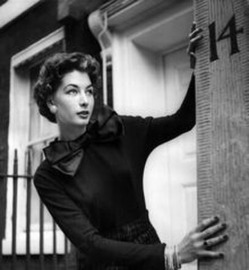 At the beginning of WWII, “Maxime” had been a “Computer” at Bletchley Park but was dismissed due to her apparent kleptomania. By the time the war ended, Maxime was married to a French noble, Count Alain Le Bailly de La Falaise, and was a veteran of the French Resistance. Before moving to Southern France with Bernard in 1961, Maxime had given the Count two children, Loulou and Alexis.
It was Bernard’s fascination with the Surrealists that drew him to Lacoste.
Among Paris’ artistes, it was well known that the Marquis de Sade hailed from Provence and Lacoste in particular. To Bernard and Maxime, their first visit to Lacoste must have felt like a pilgrimage.
By the 1960s, Lacoste was in ruins. Once prosperous for its silk production, the village had become a ghost town due to the Caterpillar Plagues of the late 1870s. Thereafter, Chinese and Japanese silk cultivators took over and beat the French and Italian sericulturists at their own game. By 1962, Lacoste was a failed village, and most of its residents had left for better prospects in Marseilles, Lyon, and Paris.
The village had neither plumbing nor electricity, but Bernard was able to trade two American-style refrigerators for the Boulangerie building at the center of town and a cluster of roofless buildings across the narrow street.
Then an acolyte of Cecil Beaton, Maxime’s initial hope had been to create an artist colony for her entourage of Parisian socialites and artists. But the dream did not last.
Some time before 1968, Maxime and Bernard fell apart. Whether this was due to her dalliances or Bernard’s fault, no one can’t say. Perhaps it was just Maxime’s desire for a bigger sandbox. By 1967, Maxime was in NYC, remarried to John McKendry, a curator at the Metropolitan Museum of Art. By 1974, Maxime was a fixture at Warhol’s Factory, performing in Paul Morrissey’s “Blood for Dracula” (1974). Together, Maxime and McKendry would play an important role in launching Robert Mapplethorpe‘s career.
Provence and the Vaucluse were not destinations for les BCBGs until the ’80s, when the ‘hippies’ like John Malkovich, Ridley Scott, and Leonard Cohen had bought inexpensive property during the ’70s and turned the Luberon Valley into a refuge for celebrities seeking anonymity.
After Maxime’s departure, Bernard decided to turn the place into a school via Sarah Lawrence College and his alma mater, the Cleveland Institute of Art.
As a staff assistant at the school during the late ’80s, I knew nothing of Maxime, Loulou, or any of the others.
 Souvenirs de Lacoste